
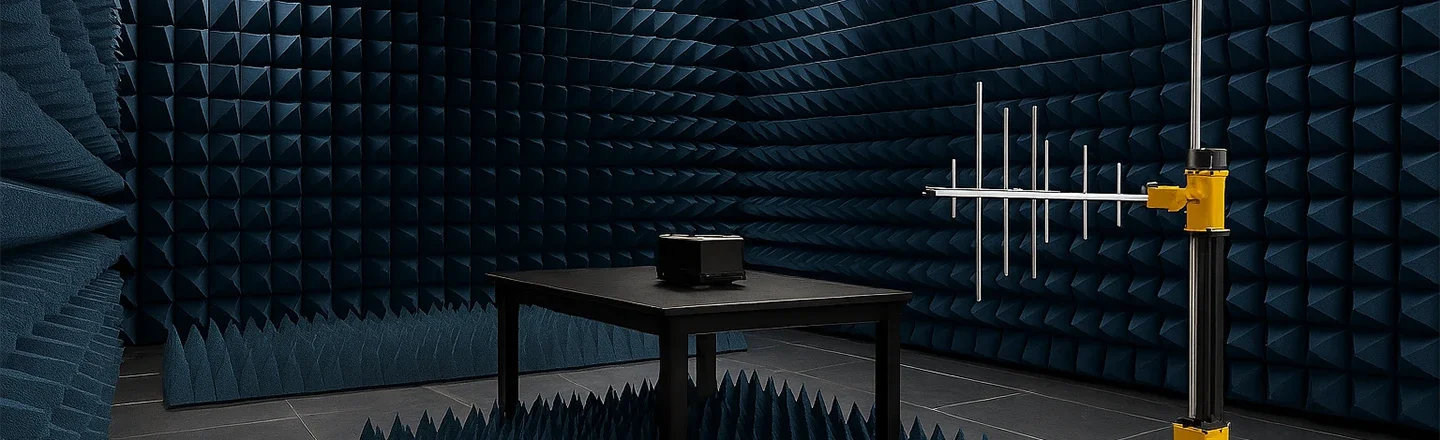
For electronics manufacturers and testing laboratories, the phase between early product development and formal regulatory compliance is where risks - and costs - tend to escalate. A failure during accredited EMC testing can lead to design rework, project delays, and additional test lab fees. PPG Cuming-Lehman prescan emissions and immunity chambers help engineering teams identify‑ electromagnetic interference (EMI) issues earlier, enabling faster iteration.
These chambers bridge the gap between bench‑top troubleshooting and full-scale compliance testing. By enabling accurate, repeatable pre‑compliance measurements in-house, organizations gain control over their development cycles and reduce dependency on external test sites.
Understanding the Pre‑Scan Chamber Architecture
A pre‑scan emissions and immunity chamber provides a controlled RF environment that isolates a Device Under Test (DUT) from ambient electromagnetic noise. Unlike fully anechoic chambers, pre‑scan chambers are typically semi‑anechoic, featuring:
- Full RF shielding on all sides
- Hybrid absorber systems on the walls and ceiling
- A reflective ground plane that simulates Open Area Test Site (OATS) conditions
This configuration mirrors common compliance test geometries used for FCC, CISPR, and IEC EMC standards. While many formal sites use a 10‑meter test distance, pre‑scan chambers perform highly correlated evaluations at 3 meters, providing early insight into emission sources and immunity vulnerabilities.
Supported Test Types
- Radiated Emissions – Identifies unintended electromagnetic energy emitted by the DUT
- Radiated Immunity – Evaluates the DUT’s resilience to external electromagnetic fields
Technical Specifications and Relevant Standards
PPG Cuming-Lehman‑ chambers are engineered to meet key commercial and industrial EMC standards, including:
- ANSI C63.4 – Methods for radiated and conducted emissions measurements
- IEC 61000‑4‑3 – Radiated RF immunity requirements
Hybrid Absorber Technology
Chamber performance relies heavily on its absorber configuration. PPG Cuming-Lehman chambers typically integrate:
Ferrite Tiles
- Optimized for 30 MHz – 1 GHz
- Thin profile preserves working volume
- Highly stable and durable
- Excellent absorption above 1 GHz
- Can be installed over ferrite for full broadband coverage
Together, these absorbers create a broadband environment supporting 26 MHz up to 18 GHz, and optionally up to 40 GHz, depending on chamber configuration.
Shielding Effectiveness and Panel Construction
Modular steel shielding panels provide > 100 dB shielding effectiveness, helping eliminate interference from:
- Cellular networks
- Wi‑Fi and Bluetooth signals
- Broadcast transmitters
- Adjacent test equipment
This isolation ensures consistent, repeatable measurements and minimizes false failures.
The PPG Cuming-Lehman Advantage
PPG Cuming-Lehman combines structural expertise‑ with advanced absorber materials from PPG’s Cuming Microwave brand, resulting in chambers known for accuracy, reliability, and long-term durability.
1. Configurable Solutions
Each chamber design can be tailored to unique facility constraints:
- Custom footprints and ceiling heights
- Flexible door placement
- Power, data, and fiber-optic filtered penetrations
- Integrated ventilation and lighting
- Specialized turntables, antenna masts, and DUT fixtures
2. Long‑Life Absorber Materials
Cuming Microwave absorbers are engineered for:
- Moisture resistance
- Structural stability
- Consistent return‑loss over years of use
This ensures the chamber maintains its acoustic performance long-term critical for repeatable EMC measurements.
Understanding EMI Pre‑Scan Testing
EMI pre‑scan testing identifies electromagnetic compatibility issues before formal certification. Performing these tests early reduces risk and accelerates development by catching potential problems while changes are still inexpensive.
Basic Pre‑Scan Workflow
- Position the DUT according to applicable test geometry
- Use antennas and receivers to sweep target frequency bands
- Identify peak emissions or susceptibility points
- Troubleshoot enclosure design, PCB layout, grounding, or shielding
- Re-test until performance stabilizes within expected limits
This iterative approach helps teams identify issues before entering costly compliance testing.
Key Specifications to Consider in a Pre‑Scan Chamber
When evaluating a chamber, engineers should consider:
- Shielding Effectiveness (SE) – Impacts accuracy and noise floor
- Frequency Range – Must support standards relevant to your product
- Internal Volume – Adequate spacing is essential for 3‑meter test setups
- Absorber Efficiency – Reduces reflections and measurement uncertainty
- Penetration Panels – Filtered pass-throughs for power and signals
- Field Uniformity – Especially important for immunity evaluations
- Expandability – Ability to adapt as products and standards evolve
A well‑selected chamber increases test confidence and streamlines preparation for certification.
Choosing the Right Chamber for Your Facility
To choose the optimal PPG Cuming-Lehman chamber, evaluate:
- Your testing goals (debugging vs. full pre‑compliance)
- Space and infrastructure constraints
- Product form factors and antenna distance requirements
- Desired correlation to external compliance labs
- Budget and required deployment timeline
The right chamber can significantly improve development workflows, test accuracy, and time‑to‑market.