
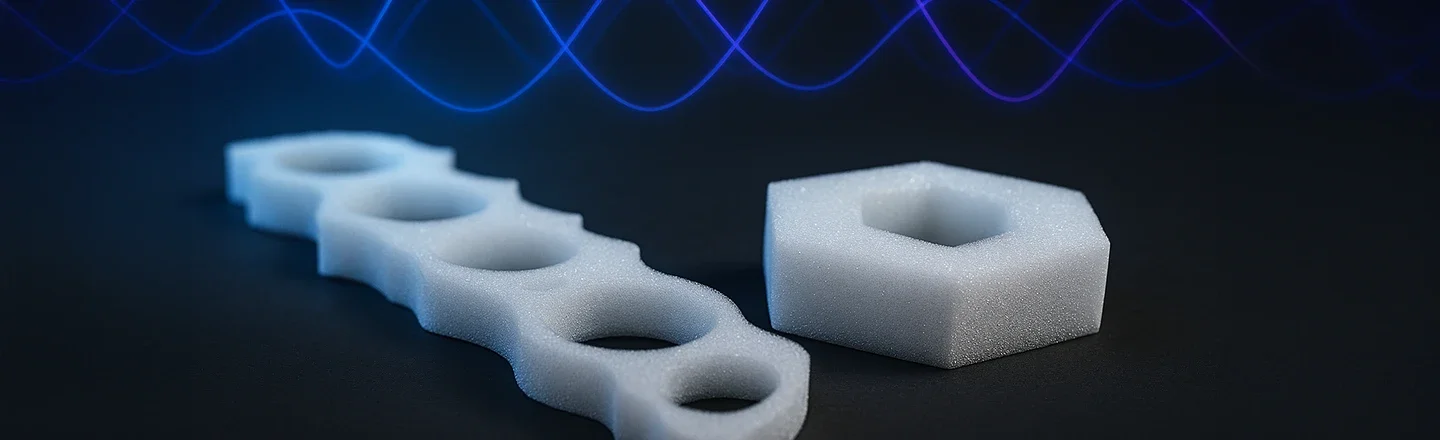
Low Loss Dielectric Materials for Precision Electromagnetic Performance
PPG Cuming Microwave manufactures a comprehensive portfolio of low loss dielectric materials engineered for advanced RF, microwave, and high‑frequency applications. With dielectric constants ranging from 1.03 to 30, our materials give engineers precise control over electromagnetic performance, enabling optimized designs across telecom, aerospace, defense, and EMC‑critical systems.
Applications of Dielectric Materials
Our dielectric materials offer unique mechanical and electrical characteristics ideal for:
- Adjusting cavity Q
- Designing impedance transitions
- Serving as stripline antenna substrates
- Supporting transmission lines and smart skins
- Acting as dielectric radomes, spacers and circuit substrates
Products are available in rod form, sheet stock, rigid foams, syntactic foams, and two‑component foaming systems. Custom fabrication services are also available for complex RF and microwave geometries.
What Is a Dielectric Material?
A dielectric material is an electrical insulator that polarizes when exposed to an electric field, enabling strong interaction with electromagnetic energy while preventing current flow. This makes dielectric materials essential components in:
- Capacitors
- RF transmission lines
- Antennas
- High‑frequency electronic devices
When exposed to an electric field, dielectric materials:
- Polarize at the atomic level
- Prevent field collapse due to leakage current
- Guide RF and microwave signals with minimal loss
- Support efficient energy storage in capacitors
Even common substances like dry air act as dielectric materials—conducting only under extreme voltages (e.g., lightning).
Key Dielectric Material Properties
Dielectric Constant (Dk / εr)
Defines a material’s ability to store electrical energy.
Higher Dk → greater energy storage in smaller volumes.
Dielectric Loss (Loss Tangent / Df)
Describes how much electromagnetic energy is dissipated as heat.
Lower Df → higher efficiency and improved high‑frequency performance.
All materials in our portfolio offer low dielectric loss, supporting performance in dense electronic assemblies and high‑frequency systems.
Featured Dielectric Materials
C‑STOCK® AK Rigid machinable High‑Dk Dielectric Material
C‑STOCK AK is a ceramic‑filled, cross‑linked plastic featuring dielectric constants from 3 to 30, delivering excellent electrical stability and low loss tangent.
Applications include:
- RF lenses
- Dielectric spacers
- Circuit substrates
- Impedance transitions
- Radomes
Unlike traditional ceramics, C‑STOCK AK is easily machinable with carbide tools.
The high‑temperature version, AK‑500, withstands continuous use up to 200°C (390°F) and short‑term use up to 260°C (500°F).
C‑STOCK LOW K Ultra‑Low Dielectric Constant Material
C‑STOCK LOW K features dielectric constants below 2.0, making it ideal for ultra‑low‑loss, high‑frequency applications.
Key features:
- Extremely low dielectric loss
- Rigid syntactic foam construction
- Fine microstructure for mechanical stability
- Minimal signal attenuation
Common applications include:
Antenna supports, waveguide insulation, coax spacers, high‑Q coil structures.
Available in 0.125 - 4-inch thicknesses as a standard thickness. Compatible with C‑Bond adhesives.
C‑STOCK .0005 Precision Polystyrene Dielectric Material
A specialty polystyrene material offering:
- Very low loss tangent
- Highly uniform dielectric properties
- Strong thermal stability
- Optical clarity
Frequently used in microwave lenses, antenna insulators and precision waveguide components.
Compatible with epoxies, acrylates and flexible urethanes.
C‑STOCK RH (PMI Foam) Structural Dielectric Material
A lightweight, ultra‑low‑loss Polymethacrylimide (PMI) foam offering:
- High mechanical strength
- Continuous thermal resistance up to 380°F
- Thermo‑formability from 325–360°F
Ideal for radome cores, RF windows, structural dielectric parts and thermal barriers.
Flexible Low‑Loss Dielectric Materials
PF‑2 and PF‑4
Closed‑cell, moisture‑resistant foams providing:
- Low dielectric loss
- Excellent weatherability
- Long‑term outdoor durability
Applications include radomes, mobile antenna systems and environmentally exposed RF assemblies.
C‑STOCK HCN
A UV‑resistant dielectric fabric, sealed with an elastomeric binder, used as:
- Protective coverings for absorbers
- Protective coverings for dielectric panels
C‑FOAM PK Foam‑in‑Place Dielectric material
A two‑component, expanding polyurethane system used to fill irregular cavities.
Ideal for:
- Radomes
- Waveguides
- Instrument housings
Available in PK‑2 and PK‑5 density grades.
Ships safely via standard carriers; containers remain nitrogen‑purged to prevent moisture absorption.
Quick Comparison Guide (Selection Aid)
| Requirement | Recommended Materials |
| Lowest Dk & loss / low mass | C‑STOCK LOW K, PF‑2 / PF‑4 |
| High Dk & excellent machinability | C‑STOCK AK (Dk 3–30) |
| High‑temperature performance | C‑STOCK AK‑500, C‑STOCK RH |
| Structural cores / radomes | C‑STOCK RH (PMI) |
| Optical clarity / precision lenses | C‑STOCK .0005 |
| On‑site cavity filling | C‑FOAM PK |
Summary
PPG Cuming Microwave provides one of the industry’s most advanced and diverse portfolios of low loss dielectric materials, supporting high‑performance RF, microwave and high‑frequency systems.
From ultra‑low‑Dk foams to high‑Dk plastics and structural dielectric cores, our materials deliver reliable performance for aerospace, defense, telecom and commercial electronics.
Ready to specify the right dielectric material or need engineering guidance?
Reach out to a PPG representative to discuss your application, request samples, or explore custom fabrication solutions tailored to your frequency band, target Dk/Df, and environmental requirements.
Connect with a PPG expert today to get started.