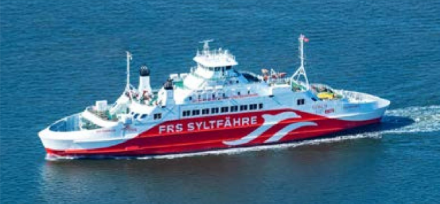
Sylt Express is a RoRo passenger ship operated by FRS Syltferry and sails between Havneby on the Danish island of Rømø and the German island resort List on Sylt. The parent company FRS (formerly Förde Reederei Seetouristik) is an international ferry operator based in the north of Germany with around 75 vessels. The company carried 5.7 million passengers and 1.5 million vehicles on its numerous national and international shipping lines in 2023. The Sylt Express is not only responsible for transporting tourists to and from List on Sylt but also for the island’s access to food, infrastructure and more.
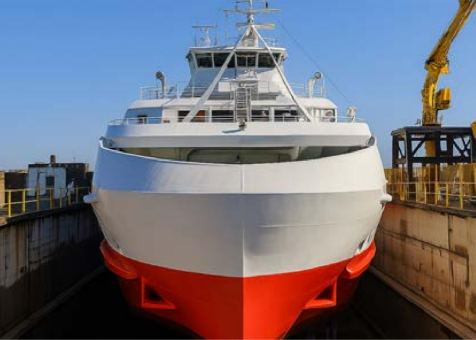
The vessel was drydocked at Esbjerg Shipyard, Denmark, in collaboration with the applicator MMT Group and industrial equipment supplier Mouritsen A/S. Mouritsen supported the shipyard and PPG with the equipment needed to ensure that the antifouling application went smoothly.
The challenge
One of FRS’s guiding principles is corporate social responsibility. It is always looking for innovative, sustainable solutions that are geared towards long-term business goals and sustainable strategies with the intent of reducing its ecological footprint.
Esbjerg Shipyard is always looking for innovations that can help it reach its sustainability goals and minimize its environmental footprint. “Operating a shipyard in the middle of a national park also brings obligations to think of more environmental and sustainable products to be used for maintenance and repair of ships,” explains Brian Mose, the yard’s Sales Supervisor.
The solution
For many years, PPG has invested in developing sustainably advantaged products, helping shipowners reach their sustainability targets. Investing in advanced hull coatings helps owners cut fuel use, lower GHG emissions and comply with IMO regulations. By reducing drag, these coatings boost efficiency and support sustainable, cost-effective operations.
One example is PPG Sigmaglide 2390, a fouling release silicone-based coating that is 100% biocide free, along with PPG Nexeon 810, which is a copper-free antifouling with reduced photodegradable biocides. These two products are unique not only due to being sustainably advantaged, but they are also suitable for electrostatic application. This spraying technique significantly reduces coating overspray and waste, minimizing the loss factor, resulting in less paint needed.
To support the customer’s needs, PPG proposed PPG Nexeon 810 as an ultra-low-friction hull coating for the ferry. As it is 100% copper-free, PPG could ensure that no copper would be released into the marine environment in relation to the coating. This ultra-low friction product also delivers immediate power and emissions savings, compared with traditional antifouling coatings, thereby reducing environmental impact.
As stated above, PPG Nexeon 810 is suitable for electrostatic coating application, a technology that has an increased paint transfer efficiency compared to airless spraying. Using an electrostatic spray gun, the charged paint droplets are drawn to the grounded hull surface like a magnet. This technique not only creates a uniform, ultra-smooth, long-lasting film layer but also significantly reduces overspray and waste. It also minimizes the need for masking the vessel and cleaning the dock post-application, saving time, materials and costs.
The result
Relying on PPG as a trusted partner, FRS Syltferry and Esbjerg Shipyard took significant steps towards achieving their sustainability ambitions, whilst not compromising on aesthetics and performance. PPG Nexeon 810 helps to improve vessel performance by delivering up to 25% emissions savings due to reduced drag, maintaining higher speeds while staying CII compliant, and improving speed by 0.5 knots, compared with traditional antifouling coatings.
The electrostatic spraying technique also greatly reduced overspray around the shipyard and contamination in the surrounding waters.