Why a straightforward coating maintenance routine is becoming a strategic advantage
For decades, onboard maintenance has relied on an assumption that every vessel carries experienced crews with the time, expertise and resources to manage complex coating systems. Increasingly, that assumption no longer reflects today’s operating environment.
Shipping companies are navigating persistent labor shortages, higher crew turnover and growing pressure to maximize efficiency between dry dockings. At the same time, vessels continue operating in some of the world’s harshest environments, where corrosion never stops. The challenge for operators is ensuring routine maintenance can be carried out consistently by crews working under increasingly demanding conditions.
This is prompting many operators to rethink onboard maintenance.
Maintenance begins between dry dockings
Every voyage exposes a vessel to saltwater, ultraviolet radiation, mechanical wear and changing weather conditions. Left untreated, even minor coating damage can develop into corrosion that requires significantly more extensive repairs during the next scheduled dry docking.
Routine inspections, localized repairs and preventive maintenance help crews stay ahead of deterioration, preserving asset integrity while extending service life.
The financial impact is significant. Studies have shown proactive maintenance programs can reduce emergency repair costs by as much as 20 to 30% while improving equipment reliability and extending component life. Across large fleets, those incremental improvements translate into meaningful reductions in lifecycle costs.
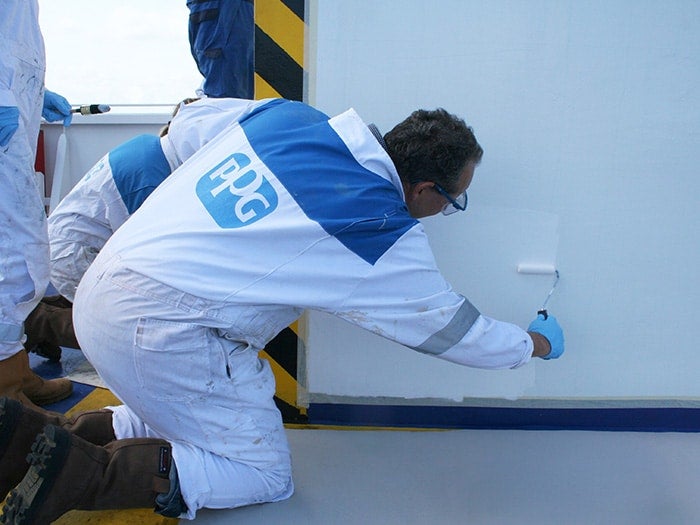
Yet onboard maintenance rarely occurs under ideal conditions. Crew members perform repairs between cargo operations, inspections, machinery maintenance and countless other responsibilities. Every additional step required to prepare, mix or manage coatings consumes valuable time that could be devoted to other operational priorities. Maintenance systems should reflect that operational reality.
Consistency has become as important as performance
Two-component coating systems are the traditional solution for many applications where maximum durability, chemical resistance, and long-term protection are required. However, routine maintenance presents different challenges. Preparing two-component coatings requires crews to accurately measure components, follow precise mixing ratios and work within limited pot life windows. In practice, these tasks are often performed in confined paint lockers while balancing competing operational demands. Small inconsistencies in preparation can affect application quality, generate unnecessary waste or delay repairs.
Ready-to-use one-component coatings eliminate many of those variables. Crews prepare the surface, stir the coating and begin application immediately without measuring components or managing curing windows.
The benefit extends well beyond convenience
Simplified application creates greater consistency across fleets. Onboard maintenance is constant, with repairs performed at sea, in port, and in all weather conditions as operational needs arise. Standardized maintenance procedures reduce variability between crews, simplify training and increase confidence that repairs are completed correctly. For fleet operators managing dozens (or hundreds) of vessels, that consistency becomes an operational advantage.
It also simplifies paint locker inventory. Rather than managing numerous base components, hardeners and thinners with different storage requirements and shelf lives, crews can work from a more streamlined inventory that reduces storage complexity while minimizing product waste.
Simplicity also supports sustainability
Environmental performance has become another consideration in routine maintenance planning. Operators increasingly evaluate coatings not only for corrosion protection but also for waste reduction, inventory efficiency and low-volatile organic compound (VOC) emissions.
Ready-to-use one-component coatings can reduce leftover mixed material requiring disposal while low-VOC formulations help support evolving environmental expectations. Simplifying routine maintenance can contribute to broader efforts to reduce waste and improve resource efficiency throughout vessel operations.
Innovation is changing maintenance
Manufacturers are increasingly developing complete maintenance ecosystems that combine simplified products with standardized training and digital fleet management tools. Ready-to-use one-component coating portfolios are one example, allowing operators to reduce application complexity while maintaining effective corrosion protection for routine repairs.
Training plays an equally important role. Standardized seastock programs that combine classroom instruction with practical onboard application help crews perform maintenance more confidently and consistently, regardless of prior coating experience.
Digital inventory management is also changing how operators manage maintenance across entire fleets. By tracking coating consumption, monitoring inventory levels and identifying recurring maintenance trends, operators gain greater visibility into fleet performance while reducing unnecessary purchases and minimizing excess stock.
Together, these innovations shift onboard maintenance from a reactive activity toward a more predictable and standardized operational process.
Charting ahead
Traditional high-performance coating systems will continue protecting critical assets where maximum durability is essential. At the same time, simplified maintenance products, standardized training and digital management tools can help make routine repairs faster, more consistent and easier to execute across global fleets.
As shipping companies continue adapting to workforce shortages, increasing operational demands and growing sustainability expectations, the question is becoming less about whether maintenance can be simplified and more about whether it can afford not to be.
Ewout Bosman is PPG Global Segment Director for Marine Seastock, Protective and Marine Coatings, where he leads international initiatives focused on sustainable maintenance strategies for the maritime industry. With almost two decades of experience in the coatings industry, Bosman brings deep expertise in segment strategy, product and portfolio management, and innovation across global markets.
Originally Published in MarineLog.