
Preserving cultural and maritime heritage is no longer only about honoring the past. Whether serving as floating museums, hotels, training vessels, or educational exhibits, historic ships face ongoing exposure to environmental stressors and heavy foot traffic.
Thoughtful maintenance and restoration efforts can help extend the life of these important structures, but maintenance is difficult to complete when the vessel cannot be removed from the water. Although historic vessels and permanently moored ship buildings no longer traverse the open seas, they face many of the same challenges as active vessels. Continuous ultraviolet (UV) exposure, saltwater, humidity, and fluctuating temperatures all contribute to deterioration that affects the vessel’s appearance and operation.
Historic vessels require a specific maintenance approach to balance aesthetics, durability, and compliance. Seastock coatings have advanced rapidly in recent years, with new high-performance coatings providing improved application efficiency and lower long-term maintenance costs.
The latest innovations in seastock coatings are becoming essential tools in maritime preservation, particularly when dry-docking is not feasible. Today’s coatings combine application flexibility and ease of use with durability and aesthetic performance to preserve vessels’ historic character while also minimizing operational and environmental impact.
The role of in-service maintenance
Many historic vessels cannot be removed from the water without compromising their public use or disrupting business operations. Dry-docking can be cost-prohibitive or too logistically complex. Museum ships often operate year-round and may host thousands of visitors weekly, while hotels and offices aboard repurposed vessels must remain accessible to avoid costly shutdowns.
Certain vessels may also hold hybrid legal or operational statuses. Some are registered as buildings rather than ships, while others are restricted by preservation regulations or tourism demands that limit maintenance windows. These constraints require coatings that can be applied quickly, cure reliably, and provide long-term protection between maintenance cycles.
The use of seastock coatings supports these maritime preservation goals to extend the service life of critical assets and maintain historical authenticity, all while embracing modern performance standards.
Seastock coating capabilities
Advances in primer and topcoat chemistry have enabled coatings that are designed for in-service maintenance. Improved adhesion and corrosion protection allow coatings to perform in demanding marine environments. For vessels with distinctive color schemes or finishes from their operational era, enhanced UV resistance may support long-term color retention.
Efficiency improvements
Long-lasting marine coatings can help reduce maintenance frequency and support extended asset life. This contributes to circular economy goals, conserves resources, and helps keep operations steady. In addition to reducing the need for new materials, coatings can also improve operational efficiency on historic vessels.
Dark steel decks can absorb large amounts of heat, thereby increasing indoor temperatures and energy demands. Reflective, light-colored topcoats can help reduce heat absorption and alleviate energy demand for cooling interior spaces. Simple changes such as these can have significant impacts on energy efficiency and occupant comfort.
Lessons from the SS Rotterdam
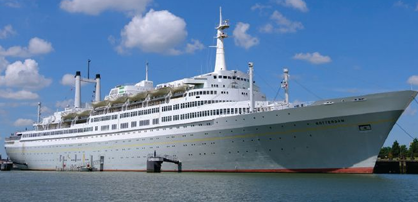
Moored in the Port of Rotterdam in the Netherlands, the SS Rotterdam exemplifies how today’s seastock coatings support maritime preservation. Once a transatlantic liner, the vessel journeyed from making transatlantic cruises to becoming a stationary hotel, restaurant, event venue, and cultural icon.
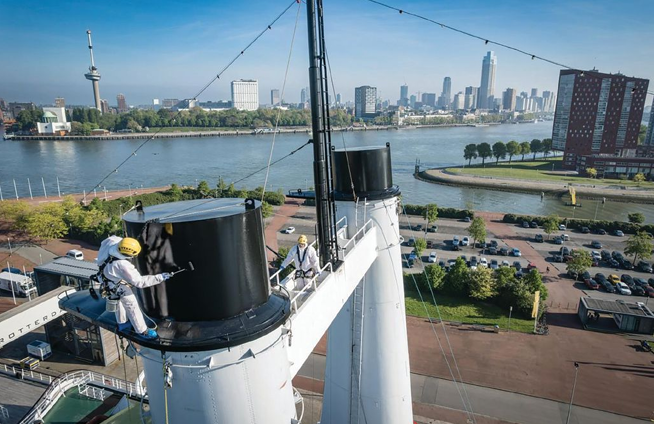
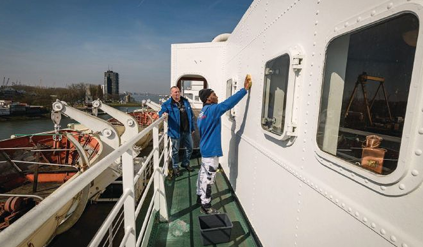
A recent refurbishment project required coatings crews to recoat large sections of the vessel within a tight, six-month time frame while working around staff and guests — a tall order considering the vessel’s scale and the logistical complexity of surface preparation, public access, and limited downtime.
Color matching was particularly important for the project. The SS Rotterdam’s earlier coatings had 18 faded, requiring a special formulation of near-exact shades. Using advanced digital color-matching technology, the crew aimed to bridge the gap between old and new without a jarring visual contrast.
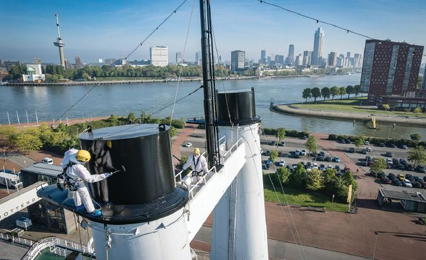
Reaching the vessel’s upper decks and funnel required innovative access solutions. Instead of traditional scaffolding or cherry pickers, rope-access technicians were used. This method minimized disruption to daily hotel operations while enabling access to the project’s complex geometries.
Despite its complexity, the project was completed ahead of schedule. The refurbishment demonstrated how well-planned sequencing, experienced applicators, and seastock coatings formulated for in-service work can align to meet tight deadlines. More than a technical success, the SS Rotterdam project demonstrates the role of coatings in preserving cultural identity and helping historic landmarks thrive in modern use.
A model for preservation and reuse
Cities around the world are repurposing decommissioned vessels as hotels, student housing, restaurants, floating offices, and cultural venues. Preserving existing structures instead of replacing or scrapping them supports circular economy practices and helps conserve valuable resources.
The adaptive reuse of heritage structures, including seafaring vessels and industrial infrastructure, reduces material consumption and keeps culturally significant spaces active and relevant. As a 2025 report published in the journal Sustainability states, “The adaptive reuse of cultural heritage sites represents a strategic approach to sustainable development, aligning architectural conservation with economic and environmental resilience.”
As these adaptive-reuse projects expand, seastock coatings will play a key role in maintaining visual appeal while supporting occupant safety and environmental compliance. Coatings are key contributors to cultural representation, sustainability, energy efficiency, and responsible resource use.
The SS Rotterdam project offers key takeaways for infrastructure and hospitality decision-makers:
- Heritage value: Maritime preservation blends craftsmanship with modern material science.
- Durability and design: Today’s seastock coatings meet functional and aesthetic requirements. They deliver high abrasion resistance and color stability, helping to support extended maintenance intervals.
- Efficiency in execution: Successful preservation work hinges on communication among contractors, vessel operators, and coatings experts
- Seastock coatings: In-service coating systems can help reduce operational interruptions.
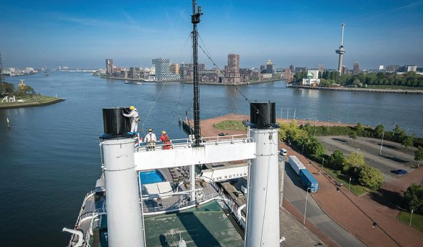
Restoration work on the SS Rotterdam and similar projects demonstrates that high-performance seastock coatings can help historic vessels remain relevant and structurally sound. As more cities and companies adapt historic and industrial sites for new use, coatings will continue to play an important role in keeping those spaces active.
Coatings help ensure that these floating landmarks can continue to serve their communities, allowing history to coexist with modern expectations for performance and environmental responsibility.
Even ships that no longer sail have stories to tell. Thanks to the continued evolution of marine coating technologies, these vessels can remain vibrant symbols of maritime heritage for generations to come.
Arend Dorsman is a PPG Key Account Manager, Protective and Marine Coatings, with 20 years of experience in advanced coatings.
Originally published in CoatingsPro Magazine.