
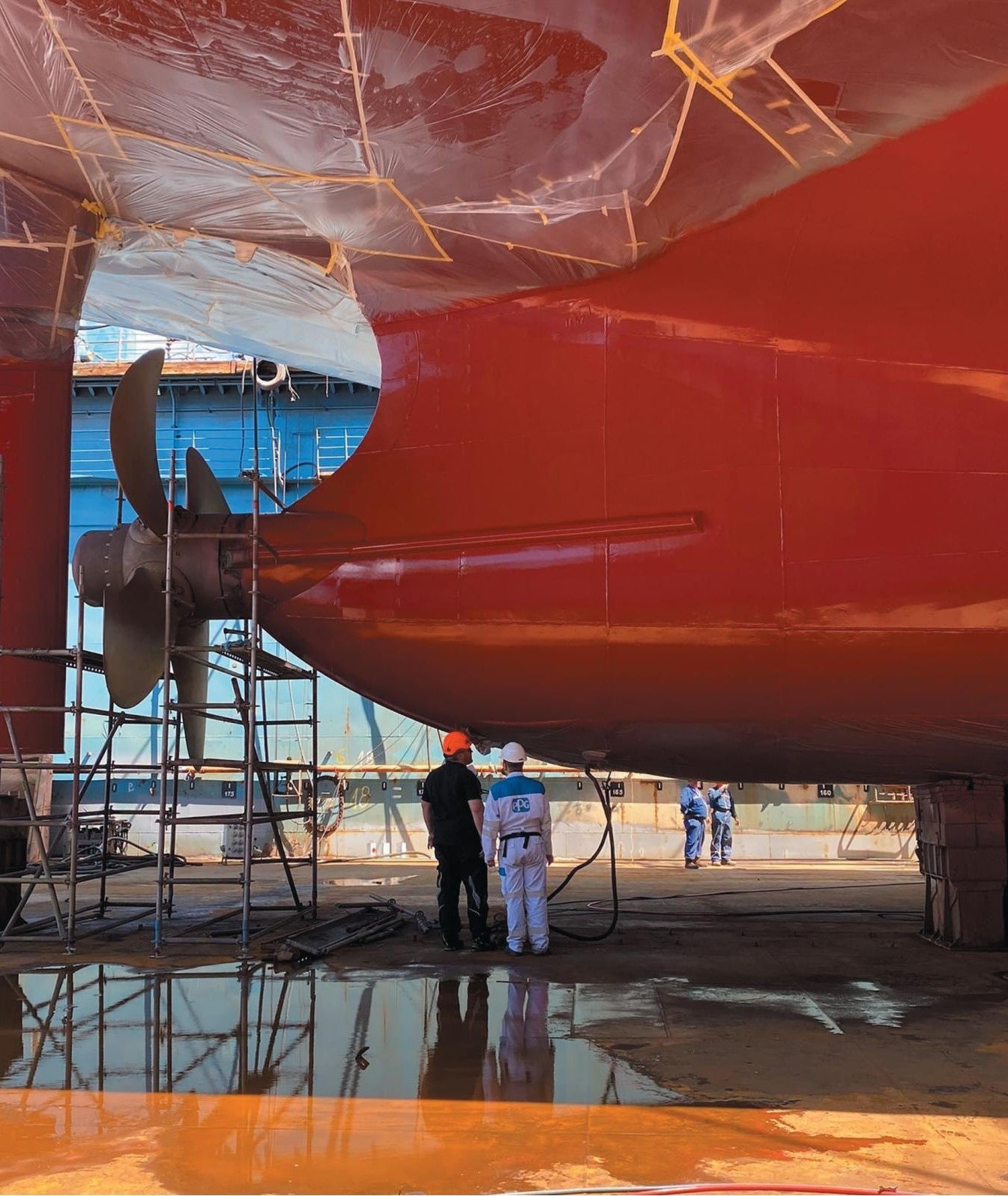
Over the last two years, demand for the transportation of critical raw materials has led to expanding global trade routes for dry bulk vessels, writes Bert Adema, Business Development Manager ESTA, PPG Protective & Marine Coatings. At the same time, regulations from the EU and the International Maritime Organization (IMO) are driving owners and operators to reduce emissions and improve vessel efficiency over the coming decades. With fuel costs also rising, technologies that can reduce operational waste while supporting improved vessel performance have become a top priority.
The Netherlands has long been a centre for maritime innovation, and it plays an important role in the adoption of new coating application technologies designed to improve efficiency across the shipping industry.
PPG’s Protective and Marine Coatings business develops hull coating technologies and solutions that help ship owners reduce emissions and lower life cycle maintenance costs. Building on more than 70 years of experience with electrostatic spraying technology in the automotive and aerospace sectors, PPG introduced electrostatic application (ESTA) to the marine coatings industry in 2023 with two compatible fouling control coatings. The technique has gained momentum for routine hull maintenance operations and continues to grow in new applications.
ESTA works by negatively charging coating particles at the spray gun nozzle while the vessel substrate is grounded. The charged particles are attracted to the steel surface, which increases transfer efficiency and reduces overspray. While electrostatic spraying has been widely used in industrial applications since the 1950s, its use with marine coatings represents a significant step forward for shipyard operations.
PPG began testing ESTA for marine applications in the Netherlands. A Dutch team was developing a hydrogen-powered sailing vessel. The project leader approached PPG to determine the feasibility of using ESTA to apply a friction-reducing hull coating in order to reduce material consumption and waste. Working closely with a small Dutch shipyard, PPG conducted early field trials that laid the groundwork for a broader development program that has since expanded to shipyards around the world.
Since the commercial introduction of ESTA for marine applications, more than 275 vessels have been coated using the technology. Shipyards and vessel operators report overspray reductions of up to 50% compared to traditional airless spraying, while also benefiting from reduced masking requirements, faster cleanup and less airborne material on applicators’ masks and clothing.
The technology has been successfully deployed on a variety of vessel types in multiple regions. At EDR Antwerp Shipyard, ESTA was used during the drydocking of the RoRo passenger vessel Stena Transporter, operated by Stena Line. By applying PPG SIGMAGLIDE ® 2390 fouling release coating electrostatically, the yard achieved a 40% reduction in overspray with improved application precision.
Dynacom Tankers Management Ltd. selected PPG coatings applied by electrostatic spray technology for the crude oil tanker Karolos during drydocking at Skaramangas Shipyard, marking the first use of ESTA in Greece. In China, PPG completed an ESTA project on the 287- metre bulk carrier Colossus at CUDWeihai Shipyard Co. Ltd., applying PPG NEXEON™ 810 antifouling coating and PPG SIGMAGLIDE ® 2390 fouling release coating to improve hull performance and increase fuel efficiency.
Additional coatings for drydock and new builds, including PPG SIGMADUR™ 1800 topcoat and PPG SIGMAFAST™ 210HS primer and topcoat, can also be used with ESTA technology.
PPG applies a comprehensive approach to vessel efficiency that incorporates advanced hull coating technologies and digital performance tools such as the PPG HullNav™ advisory and monitoring platform.
Together, low-friction hull coatings, ESTA technology and digital monitoring solutions provide shipowners with a 360° vessel efficiency strategy to meet the demanding operational and environmental requirements of maritime shipping.
Bert Adema is a PPG Business Development Manager, ESTA, for Protective & Marine Coatings. With more than 20 years in the marine coatings sector, he focuses on driving innovative application technologies and helping shipyards and owners optimize coating performance.
Originally published in Dry Cargo International.