
Most people don’t think about the shipping industry often, even though 80% of goods are moved around the world on ships each year. This massive industry relies almost entirely on fossil fuels—consuming about 300 million tonnes of fuel annually and generating 3% of the world's CO2 emissions along with significant nitrogen and sulfur oxides and particulates. With the price of oil high, ship operators are also looking for ways to reduce costs.
Ships also unwittingly transport invasive species along with them—attached to the undersides of vessels or in their ballast water. Species that make their way into non-native environments can spread quickly and damage the ecosystem and economies that rely on them significantly. For example, the zebra mussel, native to the Caspian Sea, is invasive in the Great Lakes, Canada’s St. Lawrence and Hudson Rivers, and has been found in the Chesapeake Bay. This mussel competes with native species important to fisheries and has clogged power plants and water treatment plants along the coasts.
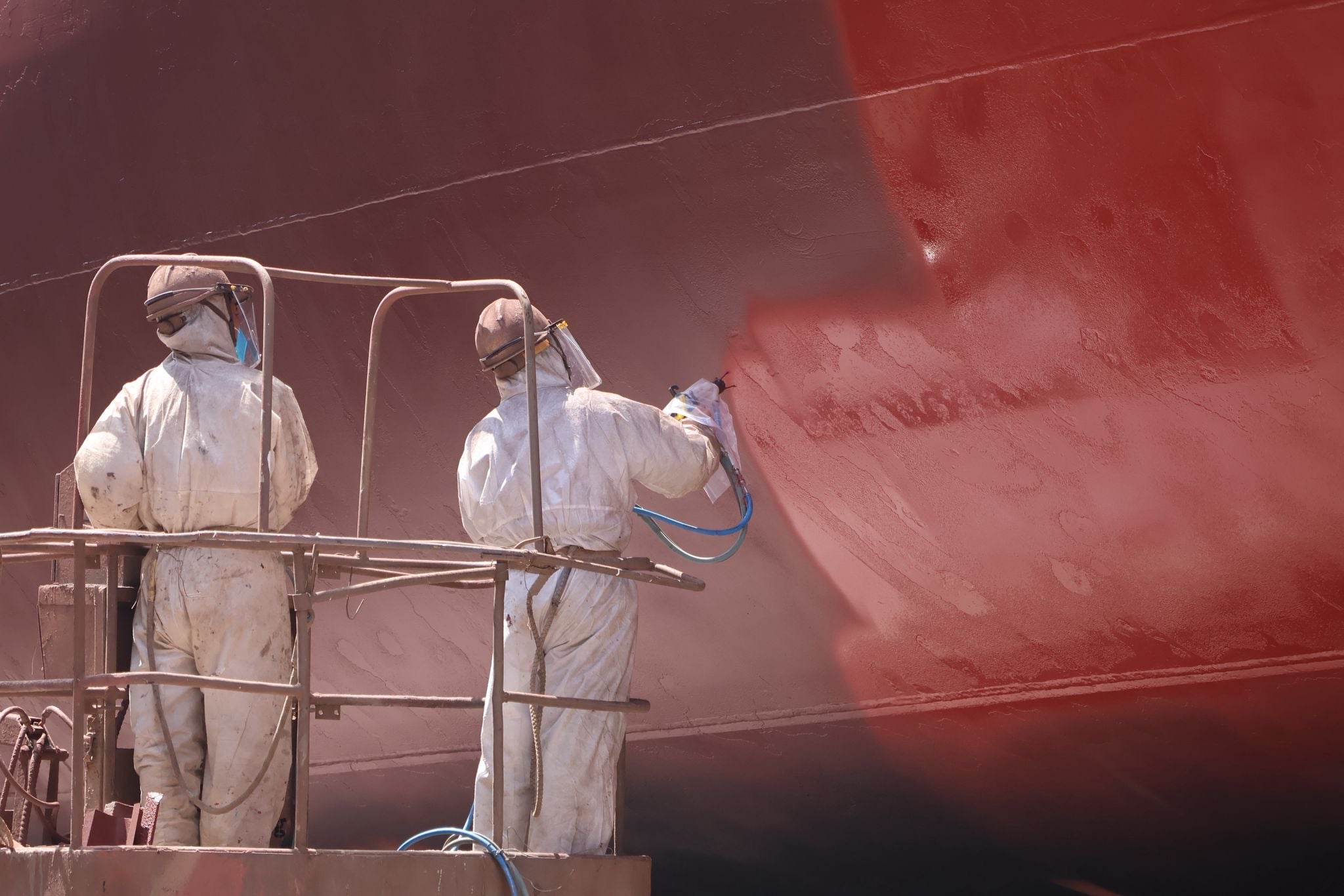
One important tool the industry has employed to deal with these issues is by applying antifouling coatings to ship hulls to prevent the buildup of slime, algae, and barnacles on the underside of vessels. Keeping the hulls clean reduces drag as the ship passes through water, saving fuel costs and reducing emissions. It also limits the transport of invasive species.
A product challenge
As the name states, part of the purpose of an antifouling paint is to prevent fouling from the aquatic organisms that are adhering to the boat hull surface. Finding a chemistry that meets this function with minimal unintended consequences is a challenge. Most coatings meet the antifouling function through the use of biocides, sometimes with biocide boosters, which both intentionally leach out of the coating. Up until an international ban 18 years ago, organotin tributyltin (TBT) was commonly used, which bioaccumulates and can negatively impact non-target species along shipping lanes and in ports. Since then, other common biocides using copper and zinc have come under scrutiny. Some biocide boosters, such as cybutryne have also being banned.
Given these challenges, an alternative was needed. So, how does one design a coating that prevents fouling from aquatic organisms while minimizing unintended consequences?
Design Innovations change processes and materials
In recent years, in addition to alternative formulations with biocides, researchers have been studying alternative processes to address antifouling. One such process that has been gaining traction is the design of fouling release coatings that employ non-stick properties rather than biocides to keep surfaces clean.
One such silicone-based formulation won a 2026 Green Chemistry Challenge Award for the Design of Safer Chemistries: PPG SIGMAGLIDE® 2390 coating. PPG’s SIGMAGLIDE® 2390 coating exemplifies the green chemistry principle of Benign by Design by eliminating biocides at the formulation stage. PPG SIGMAGLIDE® 2390 coating uses PPG HYDRORESET™ technology, a water responsive surface technology. When immersed in water, the coating becomes non-stick, ultra smooth and virtually friction-free, preventing marine organisms from recognizing or adhering to the surface of the vessel.
Reported and modeled performance indicate immediate power savings of up to 20% and potential reductions in CO2 emissions of up to 35%, depending on the vessel type and operating profiles. In addition, the low-VOC formulation can be applied electrostatically—a technique borrowed from the aerospace and automotive industry that reduces overspray, paint waste, and potential respiratory exposure to works applying the coating.
A Challenge for Adoption
While there is a cost to transition to biocidal-free coatings, investing in non-biocidal technologies can reduce long-term costs due to the longevity of the products. For example, PPG SIGMAGLIDE® 2390 coating lasts over 10 years without surface degradation, reducing the need for drydocking and reapplication compared to approximately one to two years for a conventional biocidal coating.
As regulations around marine coatings continue to evolve, biocide-free solutions like PPG SIGMAGLIDE® 2390 coating can help reduce marine pollution at its source while decreasing CO2 emissions.
Originally published by the American Chemical Society.