

Pittsburgh—The buildings rising from the top of a hill in the Allegheny Mountains north of Pittsburgh would be textbook examples of the mid-century modern style popularized by Frank Lloyd Wright—which emphasizes sharp lines connecting expanses of glass and exposed steel—if not for two factors. First, the metal members are painted red and free of the corrosion that plagues this style of construction. And second, the sharp lines of the flat roofs are broken by an army of ducts, fans, and heat exchangers.
The buildings need that equipment to properly ventilate the chemistry and materials science laboratories inside, part of PPG Industries’ flagship research and development (R&D) site. The paint and coatings firm built the facility in Allison Park, Pennsylvania, in 1974 and completed a $7.8 million upgrade in 2016. In November, the firm hosted a small group of reporters specializing in coatings and chemistry, including one from C&EN.
For a media tour, the day was surprisingly secretive. We were told well ahead of time not to bring cameras. When we arrived at 8:45 a.m., a PPG staffer was ready with stickers for our phones that covered the rear cameras under a large square and wrapped a thin ribbon around to the front to block the selfie lens. Staffers even checked that no one was wearing smart glasses.
The precautions were necessary because most of the research projects at Allison Park are conducted under nondisclosure agreements with PPG customers, said David Bem, the firm’s chief technology officer. “We don’t want to unintentionally breach that confidentiality through you,” he said.
In 2024 PPG sold its US architectural-coatings division, which includes house paint, for $550 million. Though it kept architectural-coatings units in other parts of the world, the move cemented a move away from high-volume retail sales. Throughout the day, PPG executives and research leaders outlined the high-margin, technically demanding markets the firm sees as its future.
For PPG, less can be more
The theme of helping customers use less paint came up several times during the day—not what you’d expect from a company in the business of selling paint. Part of the reason is that the company is trying to stay ahead of market trends. PPG’s annual report predicts, for example, that the number of personally owned vehicles will decrease in the coming years because of ride-sharing and other changes in how people get around. At the same time, customers in most sectors are shopping for paint formulations and application systems that let them generate less waste, both to get more value out of each can and to reduce waste disposal costs.
PPG controls about a third of the automotive-paint market, according to the investment data firm IBISWorld. There, and in other sectors, the company has plenty of room to grow by winning customers away from its competitors before it needs to worry about the impact of smaller volumes, said Peter Votruba-Drzal, PPG’s vice president for global sustainability.
Votruba-Drzal said he tries to shift customers from thinking about the cost per liter to thinking about the overall cost of their operations. “Our ability to, for example, lower energy, reduce waste, and reduce the amount of water continues to create value for our customers,” he said. About 70% of an automaker’s energy costs are in the paint shop, Votruba-Drzal said, so improvements such as lowering the temperature a coating needs to cure can have a big impact.
In another example, Bem pointed to the trend toward two-tone electric vehicles (EVs). Though he didn’t name names, “We had early prototypes here 5 years ago for EVs you’d recognize today,” he said. Car bodies are usually painted all at once in a series of dipping, spraying, and baking steps. To enable a bicolor car without tedious masking, PPG worked with the manufacturing-equipment firm Dürr to design precision sprayer robots and a line of paints for the inkjet-like devices to use. Bem said the system cuts the amount of paint needed per car by 20% and eliminates disposable masking materials.
In another market, aerospace coatings, the need for chromium for corrosion resistance means that overspray becomes a costly hazardous waste challenge, Votruba-Drzal said. There, the use of electrostatic and precision spraying improves the environmental footprint as well as the bottom line.
Each region of the globe has its own sustainability priorities, Votruba-Drzal said. In Europe, PPG scored a gain in market share for one of its French brands when it cut the paint’s carbon footprint by 20%. Mexican customers aren’t as moved by carbon dioxide reductions, he said, but they want to improve their air quality by eliminating volatile organic compounds. “They care about moving from solvent-based products to water-based products,” he said.
Fume hoods and boat coatings
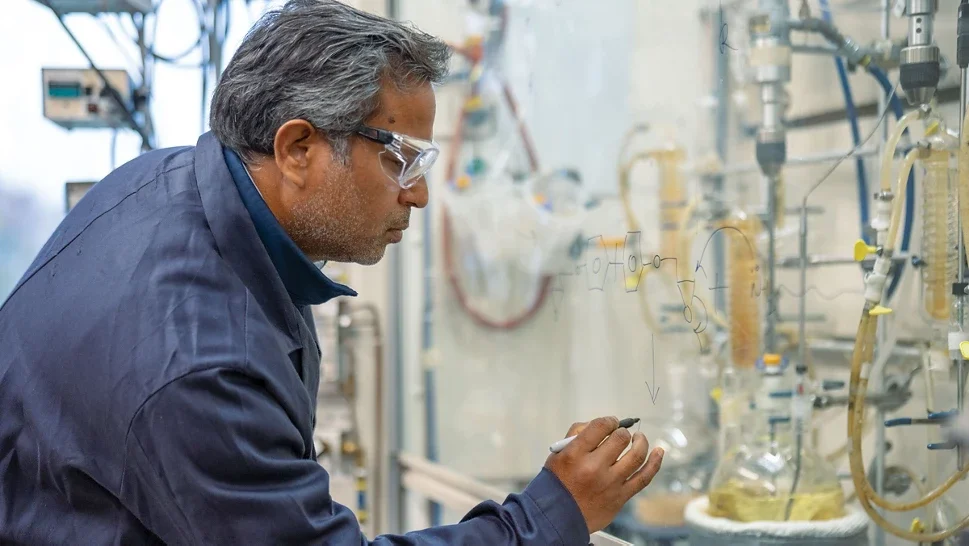
At about 11:00 a.m., after presentations by Bem and Votruba-Drzal, we all donned lab coats and goggles and headed toward PPG’s laboratories.
Any chemist who worked in an academic or industry lab built in the 1980s or ’90s would feel at home in the first set of labs we saw. Cinderblock walls painted white divided a large hangar into a set of smaller spaces, each containing two rows of beige fume hoods separated by open benchtops in the middle. The normal complement of rotary evaporators, stir plates, balances, and small analytical instruments populated every flat surface. We could peek but not enter, as the spaces were busy with researchers in the middle of a normal day’s work.
Next up was a lab staged to show off a coating that PPG released recently for the bottom of ocean-going vessels. The product, called Sigmaglide, is based on silicone instead of the conventional zinc acrylate chemistry used in anti-fouling marine paints. And it really did feel like a silicone kitchen spatula. Standard marine coatings, unsurprisingly, feel like paint on steel.
Polymer engineer Chao Wang explained that, at a microscopic level, the silicone material forms stout columns that, once submerged, capture a thin layer of water. As a result, he said, barnacles and other fouling organisms don’t even recognize the painted ship as a surface. And when they think to hitch a ride, he said, most struggle to adhere.
As is true in the automotive sector, the firm sells both coating materials and supporting systems to the marine market. One weakness of the silicone coating is that aquatic organisms do figure out the surface if the ship sits still for too long. PPG’s fix is a device that’s added to the ship’s control systems that notifies the fleet’s manager if a vessel with the coating has stayed put for too long.
Powder coats and body shops
Down two flights of stairs was Allison Park’s powder-coating area. Technical manager Sarah Mueller said powder coatings are taking market share from liquid coatings because they don’t need solvent and create less waste.
Powder coats typically consist of beads of pigment and polymer between 30 and 50 μm in diameter that are applied electrostatically to a metal object, which is then baked to fuse the beads to each other and to the surface. The packaging and electrostatic application gets 98% of the powder onto the target; users don’t lose the material that sticks to the inside of a traditional paint can.
Mueller talked about two main areas where R&D is helping powder coatings meet new market demands. In consumer products, PPG worked with the drinkware maker Yeti Coolers to develop a powder that’s free of per- and polyfluoroalkyl substances (PFAS). A lot of powder coats use polytetrafluoroethylene, also known as PTFE or by the trade name Teflon, as their polymer base. PTFE offers great durability and chemical resistance, she said, but more and more consumer product makers are moving away from it due to concerns about the chemicals building up in people and the environment. Each visitor walked away with a cute Yeti espresso cup.
By contrast, nonconsumer markets such as construction materials and industrial equipment still use PTFE to make the coatings stand up to intense conditions. Mueller said powder coatings achieve a more uniform thickness on edges and corners compared with solvent-based coatings, and those sharp features are often the first place where coatings wear off and rust starts to invade.
The last stop on the lab tour was a garage-like space dedicated to automotive refinishing. A large roll-up door on one wall suggested that this may be the spot customer cars and trucks roll in for research. This area, too, was staged for the visit, including a large diorama of a body shop in the center of the room. Mysteriously, the PPG staff here all wore lab coats with embroidered name tags reading “Michael.”
Name tags notwithstanding, PPG R&D manager Chuck Hickenboth explained that body shops use a completely different paint chemistry than do auto manufacturers because it’s impractical to bake on a coating outside the car factory. As a result, automotive refinish coatings all need to air-dry. At PPG and some other firms, factory and refinish coatings are completely different divisions.
A big challenge is matching the factory coating, a process that goes beyond simple color to include sheen, depth, and texture elements such as metallic flakes. Manufacturer databases and sample cards are the standard tools, Hickenboth said. In addition, more than 3,000 body shops have purchased a high-end system that PPG calls Moonwalk.
The Moonwalk process starts with a handheld spectroscopic instrument that operators use to scan an undamaged section of the car. The resulting data are fed into a graphics system that digitally recreates the reference paint and, in collaboration with a human operator, formulates a coating and simulates it under a range of lighting conditions.
The recipe is fed into a cabinet about the size of three laboratory fume hoods. Inside is a large bank of hoppers filled with PPG paint ingredients. Computerized cues guide the operator to slot the chosen hoppers into a dosing and mixing line. The system is set up to yield roughly 500–1,000 mL of paint, enough to fix one car at a time.
Several whole buildings weren’t on the tour, and we met only a handful of the 300 people who work at Allison Park. PPG executives said the firm is also pouring energy into food packaging, semiconductors, aerospace, battery materials, and other niche coatings.
Bem said the coatings industry is ripe for invention and new ideas. “I think coatings are now where home and personal care was 15 to 20 years ago,” he said, when a lot of products were basically interchangeable within a given application. “People aren't really doing a good job addressing the jobs to be done. You can innovate in that space.”
Originally published in Chemical and Engineering News.